
If you’ve been following the iron conversation here over the past few months, you’ll know that low iron is rarely as simple as it looks on a blood test — and that treating it with an isolated synthetic supplement is rarely the answer.
But there’s a layer to the iron story that doesn’t get nearly enough attention, even in clinical circles. And it might be exactly what’s been missing for you.
It’s called lactoferrin. And understanding what it does changes the way I think about iron entirely.
The short version
- Lactoferrin is a food protein that supports how the body handles iron, rather than just delivering a blunt dose.
- Synthetic iron can be hard on the gut. Lactoferrin works with your existing iron-handling processes.
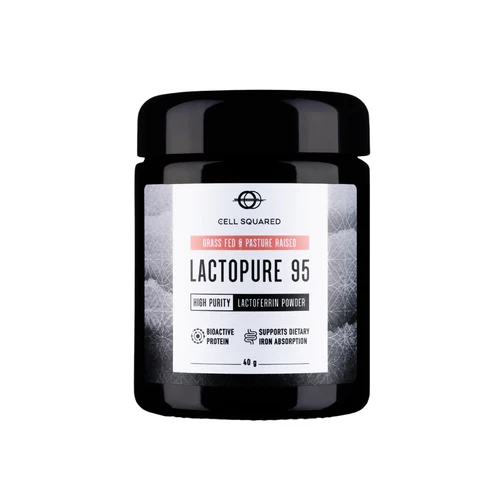
- My clinical protocol: LactoPure 95 first, then Cell Squared Beef Spleen & Liver Capsules 30 minutes later.
Try LactoPure 95
Use code TNNLACTO for a limited time discount of $20 off LactoPure 95.
What is lactoferrin?
Lactoferrin is a natural bioactive protein — one of the main proteins found in colostrum and breast milk. That alone should tell you something. The same nutrient-dense first food that nature provides to newborns, concentrated with everything needed to support iron handling and immune function from day one.
It’s not a supplement in the traditional sense. It’s a food protein. One that the body recognises, knows how to use, and responds to very differently to a synthetic iron compound.
What does lactoferrin actually do?
Here’s what makes lactoferrin so clinically interesting: it doesn’t just deliver iron. It helps the body handle iron more intelligently.
Lactoferrin works in the gut to support the body’s natural processes for recognising, transporting, and utilising dietary iron — including the heme iron from food and organ meat supplements. Rather than flooding the gut with free iron (which is what synthetic iron supplements do, and why they’re so hard on the digestive system), lactoferrin supports a more regulated, gentle process.
It also contributes to:
- Iron metabolism — supporting the body’s own systems for working with iron from food
- Gut environment — helping maintain intestinal barrier function and a balanced digestive system
- Immune function — playing a role in the body’s natural defences
- Antioxidant defence — supporting the body’s ability to manage everyday oxidative stress
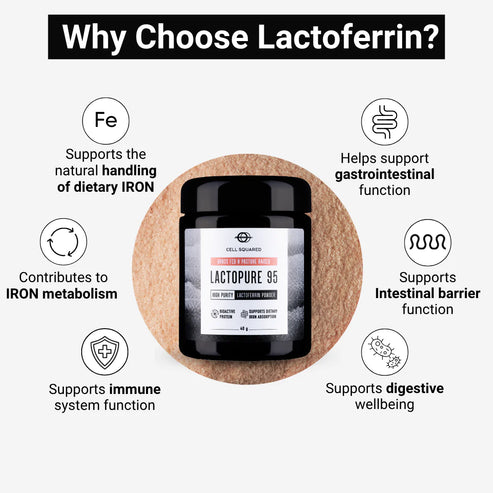
Synthetic iron supplements deliver a blunt dose. Lactoferrin supports the regulation of how iron is handled. These are fundamentally different mechanisms.
Why this matters for women with low iron
For women who have struggled with iron levels despite supplementing, or who simply can’t tolerate synthetic iron, this is a meaningful distinction.
When synthetic iron is taken — ferrous sulfate, ferrous fumarate, ferric carboxymaltose — it generates a significant oxidative load in the gut. It can disrupt the intestinal microbiome, cause constipation and nausea, and in the case of IV iron (specifically ferric carboxymaltose, marketed in Australia as Ferinject), carries a documented risk of hypophosphataemia that now carries a boxed warning in the US. This is not a minor footnote.
Lactoferrin works with the body’s existing iron handling processes, not against them. For women with heavy periods, gut dysfunction, a history of poor iron absorption, or a pattern of not tolerating synthetic supplementation, it changes what’s possible.
Why LactoPure 95, specifically?
Not all lactoferrin products are equivalent. Cell Squared’s LactoPure 95 is a minimum 95% pure lactoferrin powder — sourced from grass-fed, pasture-raised New Zealand dairy cows, gently processed and freeze-dried to preserve its natural bioactive structure. No fillers, no flow agents, nothing added.
The 300mg recommended serve is the amount studied in human research for everyday nutritional support — not a token inclusion. Cell Squared have been explicit about why they don’t add a small amount of lactoferrin into their organ capsules: a 10–50mg dose offers no meaningful benefit. The product was created as a standalone to deliver a serve that actually does something.
At $1.39 per serve for a 4+ month supply, with free shipping, it’s also genuinely accessible.
Try LactoPure 95
Use code TNNLACTO for a limited time discount of $20 off LactoPure 95.
The protocol I recommend
The way I use lactoferrin in clinical practice is as a companion to food-first iron strategies — specifically alongside Cell Squared’s Beef Spleen & Liver Capsules, which provide concentrated heme iron alongside the full cofactor complement the body needs to use it.
The protocol is straightforward:
This timing matters. It gives lactoferrin the opportunity to work in the gut before the heme iron arrives — supporting the environment in which absorption happens rather than just delivering iron into it.


Shop the protocol
Cell Squared Organic Beef Spleen & Liver Capsules. Concentrated heme iron with the cofactors it needs.
The bigger iron picture
Lactoferrin is one piece of a much larger conversation about iron — one that includes root cause investigation, full iron studies (not just ferritin), understanding the role of hepcidin, cofactor status, heavy menstrual loss, and gut absorption.
Masterclass, now on demand
Rethinking Low Iron
If you want the full clinical picture — everything from why your ferritin number doesn’t tell the whole story, to how to interpret your iron studies, to what’s actually happening when synthetic iron fails — Rethinking Low Iron is now available on demand.
This is the masterclass I wish existed when I started seeing the same patterns repeat in clinic. It covers the root causes, the reference ranges, and why most iron supplements fail — including the mechanism behind why IV iron carries risks that most women are never told about.
And if you’d like to try LactoPure 95, you can find it here via Cell Squared. Use code TNNLACTO for a limited time discount of $20 off LactoPure 95.